Philosophy & Influences
Four threads run through everything I make, whether it lands on skin, canvas, or an object: the logic of natural form, the weight of history, an old philosophical question about images and truth, and the imagined futures of science fiction.
What Grows Doesn't Repeat Itself
No two rivers erode a stone the same way. No two trees grow around an obstacle the same way twice. That refusal to repeat is at the center of how I think about composition — especially in watercolor work, where pigment moves and settles with its own logic, not fully under the artist's control.
I don't try to fight that unpredictability. I build structure that can hold it — a drawing underneath that gives the organic movement somewhere to land, the same way a riverbed shapes water without dictating every ripple.
What Time Leaves Behind
My work carries traces of movement, history, and reconstruction — fragments that look like they've survived something, the way a ruin or an old fresco does. A structure half-standing tells you more about time than a building that's never been touched.
That's part of why I don't aim for a clean, finished-looking image. A tattoo, like a fragment of architecture, should carry evidence of its own history — the decisions, the interruptions, the parts left unresolved on purpose.
No Image Is the Whole Truth
Plato argued that the physical world is a collection of imperfect copies of ideal forms — that no single chair, no single image of beauty, ever fully captures the idea it's reaching toward. I think about tattoos the same way.
A tattoo copied directly from a reference photo is a copy of a copy — twice removed from whatever made the original meaningful. My abstract approach starts from the story or feeling itself, not a picture of it, and tries to build something that points toward that truth directly, rather than photocopying someone else's approximation of it.
Bodies That Aren't Finished Yet
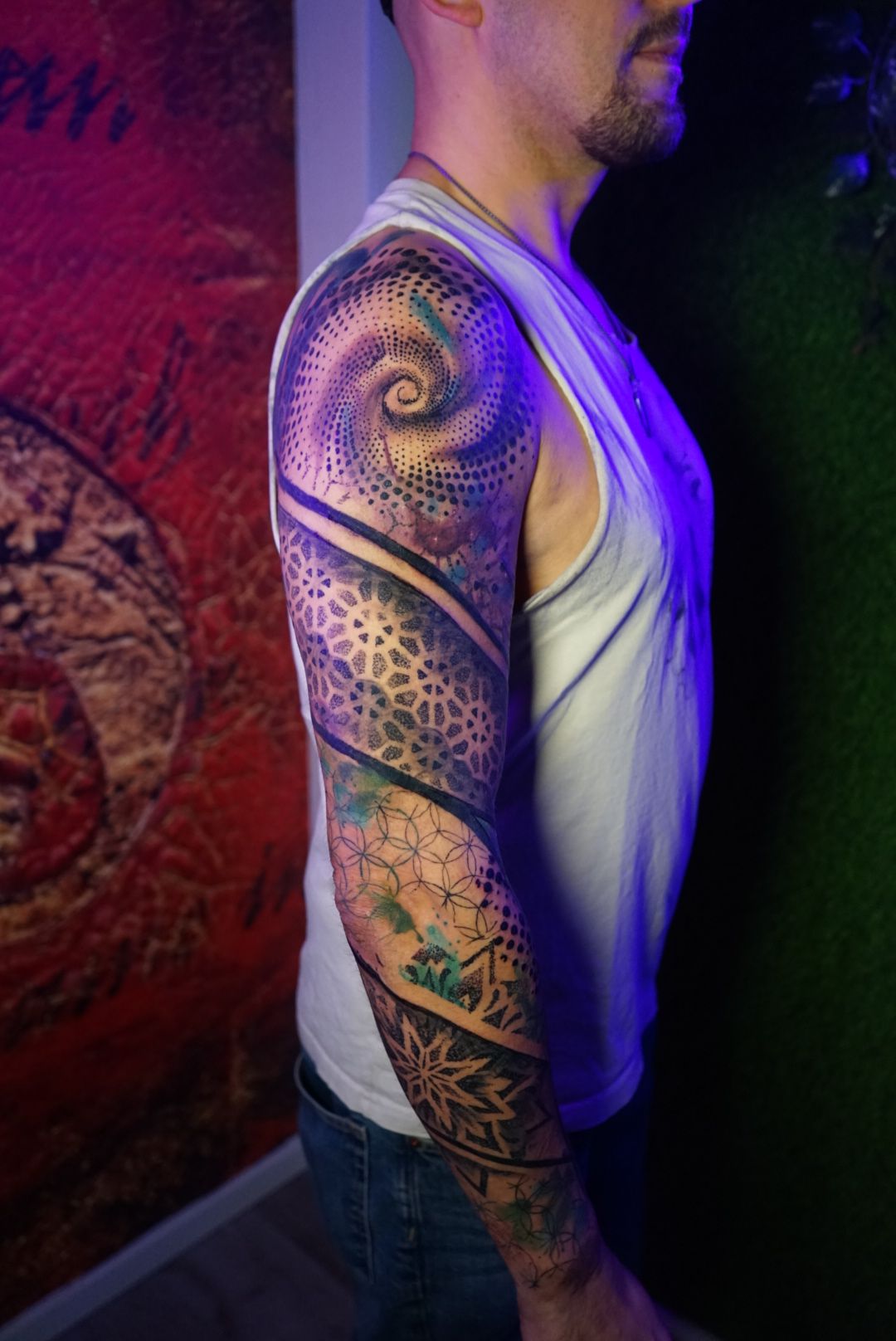
Science fiction has always treated the body as something unfinished — augmented, hybrid, in transition. That idea shows up in my work as fragmentation and controlled chaos: shapes that suggest a body mid-transformation rather than a static, completed image.
It's also where my thinking about AI and image-generation tools comes from. A machine can generate an image, but it can't imagine a future the way science fiction does — from inside a body, with stakes, with fear and wonder attached. That's still a distinctly human act, and it's one I try to put into the work.
Where These Ideas Show Up
Common Questions
What inspires UberDerek's tattoo designs?
Four things, consistently: the organic logic of natural forms, the way history leaves visible traces on structures and objects, Plato's idea that no single image fully captures the truth it points to, and science fiction's imagination of transformed and hybrid futures. These threads run through the tattooing, painting, and sculpture equally.
How does philosophy actually influence the tattoo work?
Most directly through the abstract, non-reference-based approach: rather than reproducing a fixed image, each piece is built as an approximation reaching toward an idea, story, or feeling — closer to Plato's account of forms than to photographic reproduction. The composition often carries traces of natural growth or architectural erosion, and sometimes a speculative, science-fiction sense of the body as a site of transformation.
Bring the Beginning of an Idea.
If any of this resonates, that's usually a good sign we'll work well together. Every project starts with a free video consultation, wherever you are in the world.